Disclaimer: Devoted Grandma is reader-supported. If you purchase anything through my site, I may receive a small commission (at no cost to you). Thank you.
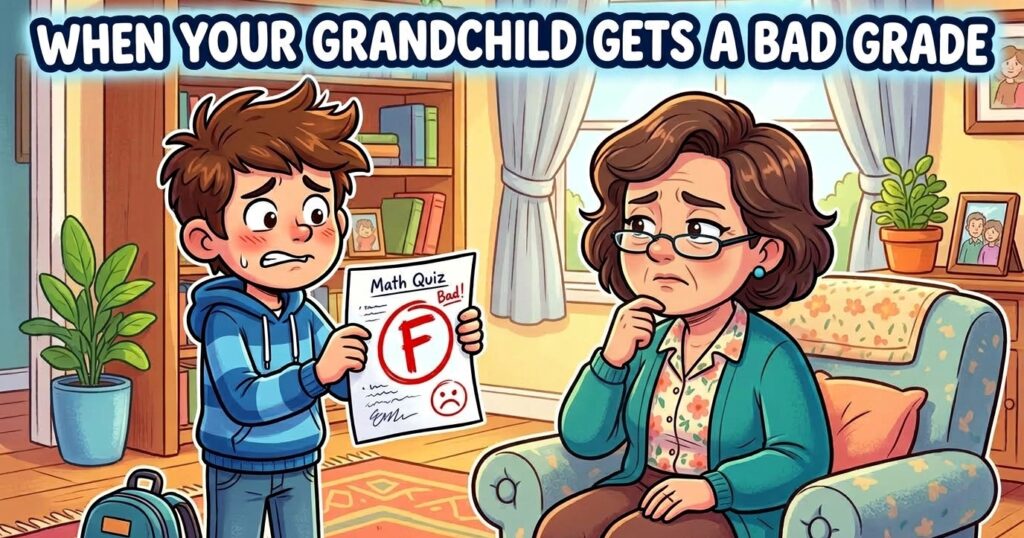
Your 12-year-old grandson, Ethan, comes over after school looking unusually quiet. He drops his backpack by the door, heads straight to the kitchen table, and barely touches the snack you put in front of him.
After a few minutes, he pulls a crumpled math test from his backpack and slides it toward you.
A big red 52% is written across the top.
“I’m so stupid,” he mutters. “Dad’s going to be really mad. I studied, Grandma. I really did.”
Your heart sinks. You know Ethan has been struggling with math lately, and you also know his parents care deeply about his schoolwork. Part of you wants to reassure him immediately. Another part worries that if you make too little of the grade, he may think it doesn’t matter.
Ethan looks at you and asks, “What am I supposed to do now?”
What would you say?
A. “Oh, sweetheart, it’s only one test. Don’t worry about it. Your dad will get over it.”
B. “I can see how disappointed you are, especially since you studied. One grade doesn’t tell me how smart you are. Let’s figure out what was hard and what you might do next.”
C. “Well, if you studied and still got a 52, maybe you need to study much harder next time.”
D. “You’d better tell your dad right away before he finds out himself. Maybe if you apologize, he won’t be as upset.”
A bad grade can feel surprisingly big in a child’s world.
To us, it may be one math test among hundreds they’ll take over a lifetime. To a child, however, that red number can suddenly seem like proof of something much larger: I’m not smart. I disappointed everyone. I’m in trouble. Maybe I can’t do this.
That’s why the first few words we say can matter so much.
When Ethan says, “I’m so stupid,” he isn’t really asking his grandmother for a mathematical analysis of his test score. He is telling her how the experience has made him feel about himself.
Before he can think about improving, he needs someone he trusts to help separate what happened from who he is.
Let’s look at each response.
Option A: “Oh, sweetheart, it’s only one test. Don’t worry about it. Your dad will get over it.”
This response comes from a loving place.
Many grandmothers instinctively want to take away a grandchild’s pain. We’ve lived long enough to know that one disappointing test will not determine a child’s future.
And there is truth in that.
But telling Ethan “don’t worry about it” may accidentally dismiss something that feels very real to him.
He is worried.
He studied. He tried. He still did poorly. And now he’s afraid of disappointing his father.
When we immediately tell a child not to worry, the child may hear, “Grandma doesn’t understand why this matters to me.”
There is another small problem with this answer. Saying, “Your dad will get over it,” puts Grandma in the middle of the parent-child relationship. Even when we disagree with how our adult children handle certain situations, it is usually better not to predict, excuse, or criticize the parent’s reaction.
Ethan needs support without Grandma taking sides.
Option B: “I can see how disappointed you are, especially since you studied. One grade doesn’t tell me how smart you are. Let’s figure out what was hard and what you might do next.”
This is the best response.
Notice what Grandma does first.
She acknowledges the feeling.
“I can see how disappointed you are.”
Those few words tell Ethan, I see you. I understand why this hurts.
She also recognizes his effort: “Especially since you studied.”
That matters because children need to know that the adults who love them notice more than outcomes.
Then Grandma gently challenges the harsh conclusion Ethan has made about himself.
He said, “I’m stupid.”
She doesn’t lecture him or say, “Don’t say that.”
Instead, she calmly says, “One grade doesn’t tell me how smart you are.”
That separates the child from the performance.
A test can reveal that a child misunderstood fractions, rushed through problems, became anxious, or needs more practice. It cannot measure the full worth or intelligence of a human being.
Finally, Grandma moves toward problem-solving.
“Let’s figure out what was hard and what you might do next.”
That word next is powerful.
Instead of treating the bad grade as a verdict, she treats it as information.
Maybe Ethan misunderstood one kind of problem. Maybe he needs to ask his teacher for help. Maybe his study method wasn’t effective. Maybe he knew the material at home but froze during the test.
Whatever the reason, Grandma is helping him move from shame to curiosity.
That is an enormously useful skill for children to develop.
Option C: “Well, if you studied and still got a 52, maybe you need to study much harder next time.”
This answer may sound practical, but it skips an important question:
Why didn’t the studying work?
More effort is not always the solution.
A child can study for hours using a method that doesn’t help him understand the material.
He might reread notes when he actually needs practice problems. He might memorize steps without understanding them. Or he may simply need someone to explain the concept in a different way.
Telling Ethan to “study harder” may also reinforce the thought already worrying him: I tried my best, and my best still wasn’t good enough.
A more helpful approach is to investigate before prescribing.
“What kinds of questions were hardest?”
“Was there anything on the test that surprised you?”
“Would it help to go over it with your teacher?”
Those questions teach a child how to learn from mistakes rather than fear them.
Option D: “You’d better tell your dad right away before he finds out himself. Maybe if you apologize, he won’t be as upset.”
There is one helpful idea hidden here: Ethan probably should talk honestly with his father.
But framing the conversation around avoiding anger turns the grade into something almost shameful.
Ethan doesn’t need to apologize for struggling with math.
He may need to take responsibility for something specific if he ignored homework or didn’t prepare. But in this situation, he says he studied.
The more important lesson is honesty, not fear.
Grandma could later say, “Your dad may be disappointed about the grade, but you can tell him the truth about what happened and what you want to do differently.”
That helps Ethan face the situation with courage.
The Grandma Lesson
Grandchildren will bring us all sorts of disappointments over the years.
A bad grade.
A missed goal.
A lost game.
A friendship that falls apart.
A rejection from a team, school, or job.
We cannot protect them from every disappointment, nor should we try.
What we can give them is a safe place where disappointment does not become shame.
When a grandchild struggles, we can help them learn three important truths:
This happened.
It hurts.
And we can figure out what comes next.
Sometimes the most valuable thing a grandmother can say is not, “Everything is fine.”
It is:
“I know this is hard. I’m here. And one difficult moment does not define you.”
That kind of reassurance does more than soothe a child after a bad grade.
It teaches them how to face setbacks for the rest of their life.