
Disclaimer: Devoted Grandma is reader-supported. If you purchase anything through my site, I may receive a small commission (at no cost to you). Thank you.
Your 11-year-old granddaughter, Mia, comes home from school looking crushed. She drops her backpack by the door and quietly tells you that two girls she usually sits with at lunch moved to another table and didn’t invite her to come along.
Her eyes fill with tears.
“They don’t like me anymore,” she says. “I don’t even want to go to school tomorrow.”
You love Mia dearly, and part of you wants to help her see that this probably isn’t the disaster it feels like right now. You remember plenty of childhood friendships that changed from week to week.
You also don’t want her to become overly sensitive or assume every disappointment is a catastrophe.
So you consider what to say.
A. “Oh, sweetheart, this is nothing to cry about. Friends change all the time. Tomorrow you’ll probably forget all about it.”
B. “Those girls don’t sound like very good friends. You should just find some nicer girls to sit with.”
C. “I know it feels awful, but try not to think about it tonight. Let’s watch a movie and get your mind off it.”
D. “That sounds really painful. Being left out can hurt, especially when you weren’t expecting it. Do you want to tell me what happened?
Most grandmothers would never deliberately dismiss a grandchild’s feelings.
In fact, when we say things such as “It’s not that bad,” “Don’t worry about it,” or “You’ll get over it,” our intention is often loving. We have lived long enough to know that many childhood heartbreaks eventually pass.
We want to lend our grandchildren some of that perspective.
But there is an important difference between helping a child gain perspective and telling a child that her feelings are too big for the situation.
That difference can have a powerful effect on whether a grandchild continues bringing her vulnerable moments to us.
Let’s look at each response.
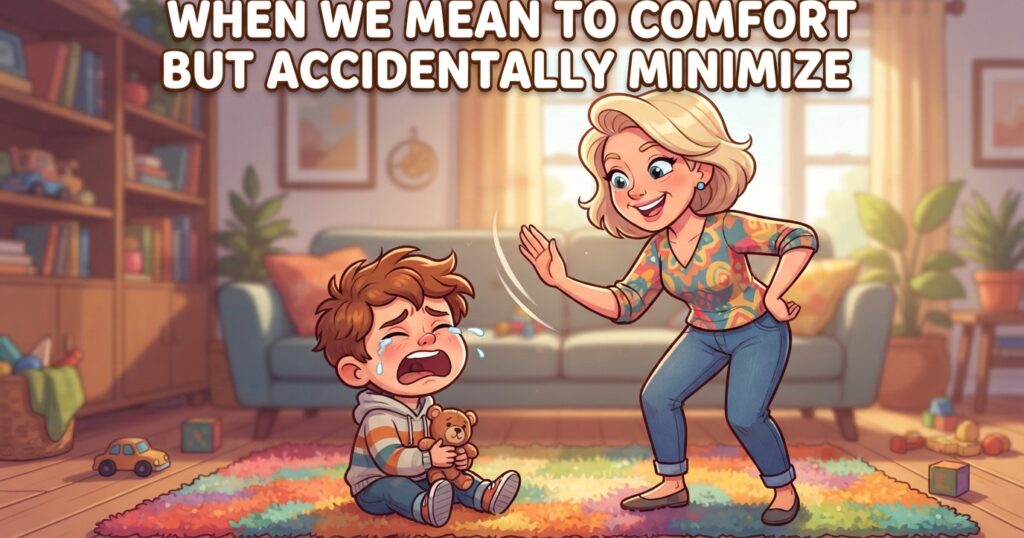
A. “This is nothing to cry about.”
This response comes from a very understandable place.
You can see the larger picture. Mia cannot.
You know that one difficult lunch period does not determine her entire social life. You may even suspect that the girls’ decision had nothing to do with Mia personally.
But telling her there is “nothing to cry about” sends an unintended message:
Your feelings don’t make sense to me.
Children and preteens are still learning how to understand and regulate powerful emotions. They do not always need adults to agree with their interpretation of events—but they do need to feel that their emotional experience is allowed.
If Mia hears, “This is nothing to cry about,” she may stop crying.
But that doesn’t necessarily mean she feels better.
She may simply learn that Grandma is not the person to cry in front of.
That is a much bigger loss than a few tears at the kitchen table.
B. “Find some nicer girls.”
This response is wonderfully protective.
When someone hurts our grandchild, the grandmother bear in us can appear very quickly.
We want to solve the problem.
But immediately labeling the other children as “bad friends” may rush past something Mia needs first: the chance to tell her story.
Maybe the girls intentionally excluded her.
Maybe there was a misunderstanding.
Maybe they were joining another group and assumed Mia would follow.
Maybe Mia had argued with one of them earlier in the day.
We simply don’t know yet.
When we leap straight into judgment or problem-solving, children can feel as though the conversation has been taken out of their hands.
Before helping Mia decide what to do, it is wiser to understand what happened—and what she is feeling about it.
C. “Let’s get your mind off it.”
Distraction is not always a bad thing.
A warm meal, a favorite movie, a walk, or a little laughter can absolutely help children settle after an upsetting experience.
The problem is timing.
If distraction comes before acknowledgment, Mia may hear:
These feelings are uncomfortable. Let’s make them disappear.
Emotional resilience does not mean learning how to avoid difficult feelings.
It means learning that feelings can be experienced, understood, expressed, and eventually moved through.
Once Mia has had a chance to talk, a movie together might be exactly what she needs.
But first, she needs connection.
D. “That sounds really painful. Do you want to tell me what happened?”
This is the strongest response.
Notice what Grandma is not doing.
She is not declaring that Mia’s friendship is ruined.
She is not criticizing the other girls.
She is not confirming Mia’s fear that nobody likes her.
And she is not trying to talk her out of feeling hurt.
Instead, she is acknowledging the emotion:
“That sounds really painful.”
Then she opens the door:
“Do you want to tell me what happened?”
That simple invitation gives Mia something every child needs when emotions are running high: the experience of being understood before being advised.
Listening first also gives Grandma valuable information.
Mia might say, “They whispered and moved when I sat down.”
Or she might say, “They joined some girls from soccer, and I didn’t know if I was invited.”
Those are very different situations requiring very different guidance.
Once Mia feels heard, Grandma can gently help her think.
She might eventually ask, “What do you think you’d like to do tomorrow?” or, “Would it help to talk to one of the girls?”
Now Mia is learning something far more useful than simply “Don’t be upset.”
She is learning how to process an upsetting experience.
Feelings Don’t Need to Be Logical to Be Real
One of the gifts grandparents bring is perspective.
We know heartbreak passes.
We know friendships change.
We know that one embarrassing moment, one bad grade, one lost game, or one unreturned text rarely matters forever.
But our grandchildren have not lived long enough to know that yet.
They borrow our calm before they can fully create their own.
And sometimes the most comforting thing we can give them is not perspective right away.
It is presence.
A grandchild who hears, “Tell me about it,” learns:
Grandma can handle my feelings.
I don’t have to hide when I’m hurting.
Someone I love wants to understand me.
There will be time later for wisdom.
There will be time for advice.
There will even be time to say, gently, “I know this feels enormous today, but I believe you’re going to be okay.”
But connection comes first.
Because when children feel heard, they become far more willing to hear us too.
And perhaps that is one of the sweetest privileges of being a grandmother: becoming the safe place where a grandchild never has to prove that her feelings are “big enough” to deserve comfort.



