Disclaimer: Devoted Grandma is reader-supported. If you purchase anything through my site, I may receive a small commission (at no cost to you). Thank you.
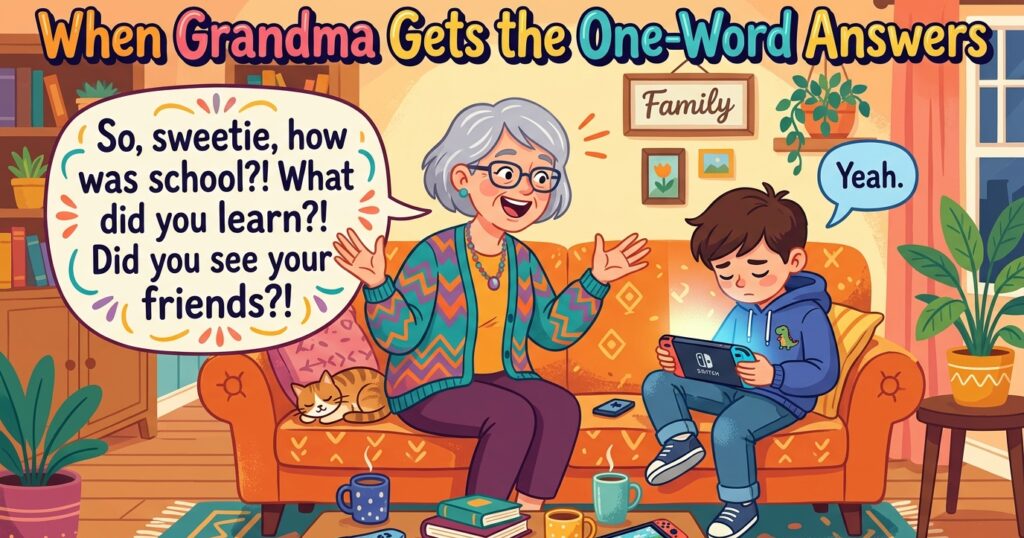
You’ve been looking forward to seeing your 13-year-old grandson all afternoon.
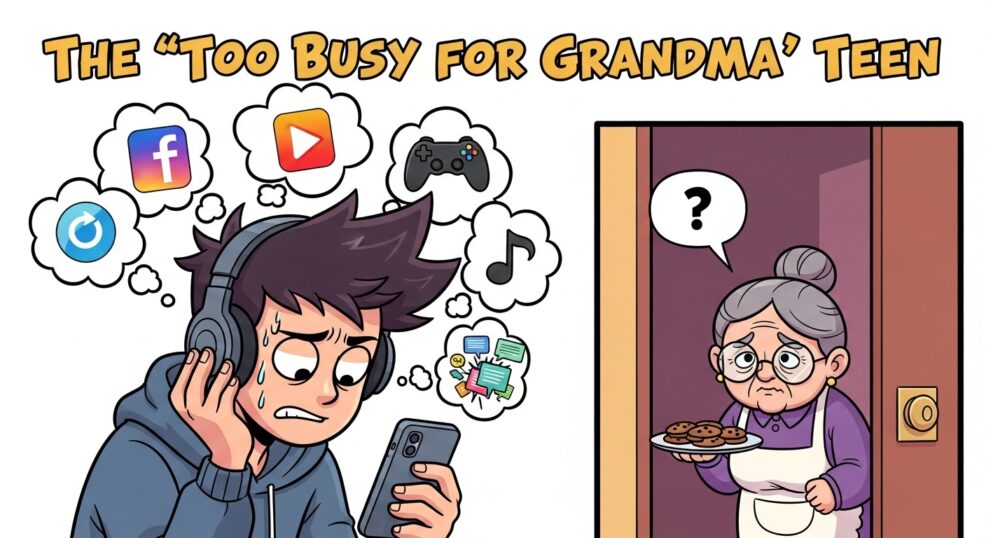
When he finally comes through the door after school, he drops his backpack beside the couch, grabs a snack, and settles into a chair with his phone.
You smile.
“How was school?”
“Fine.”
“Anything interesting happen?”
“No.”
“How did that science presentation go?”
“Okay.”
“Did you sit with your friends at lunch?”
“Yeah.”
You try one more.
“Is everything all right?”
He sighs.
“Grandma, I’m fine.”
And just like that, you feel the little door between you close.
You’re not trying to interrogate him. You simply miss the days when he would tumble through the door bursting with stories—who got in trouble, what happened at recess, what his teacher said, and what ridiculous thing his best friend did.
Now, getting three words out of him feels like an accomplishment.
Part of you worries that if you stop asking questions, you’ll grow even farther apart. But another part wonders whether all those questions are actually pushing him away.
There is a particular kind of ache that comes with getting one-word answers from a grandchild who once told you everything.
It can feel like losing a little piece of the relationship.
But often, Grandma, what has changed isn’t the love between you. What has changed is how your grandchild connects.
As children move toward adolescence, many become more private. They are developing independence, sorting through complicated social experiences, and becoming more conscious of how they appear to other people. After a full day of school—teachers, classmates, expectations, noise, decisions, and emotions—they may also simply be tired.
So when Grandma lovingly asks question after question, the child may experience something very different from what Grandma intends.
Grandma thinks: I’m interested in your life.
The grandchild may hear: I have to give an account of my day.
That difference matters.
Why A is understandable but can backfire
A says to keep asking gentle questions in hopes that he eventually opens up.
This comes from a beautiful place. Questions are one of the ways we show interest.
And sometimes one thoughtful question really does open a door.
But when a child is already responding with “fine,” “no,” and “okay,” continuing to ask questions can unintentionally turn conversation into an interview.
Think about how it feels when someone keeps asking you questions at the exact moment you don’t feel like talking. Even perfectly kind questions can begin to feel like pressure.
The pattern can become:
Grandma asks.
Grandchild gives the shortest possible answer.
Grandma senses distance and asks another question.
Grandchild feels more pressure and withdraws further.
Grandma becomes more worried and asks another question.
Soon both people are frustrated—even though Grandma’s original goal was closeness.
Sometimes the best way to invite conversation is to stop chasing it.
Why B puts too much responsibility on the child
B suggests telling him that his short answers hurt Grandma’s feelings.
Again, this response is deeply understandable.
Grandmothers have feelings, too. And when someone we adore seems uninterested in talking to us, it can sting.
But telling a grandchild, “It hurts me when you don’t talk to me,” can place an emotional responsibility on the child that doesn’t belong there.
Instead of talking because he genuinely wants to connect, he may begin talking because he feels guilty.
Those are very different kinds of conversation.
We want grandchildren to learn that Grandma’s love is a safe place—not something they must maintain by performing affection correctly.
There may certainly be appropriate moments to talk about mutual kindness and respectful communication. But the quiet ride home after a long school day probably isn’t the moment to make Grandma’s emotional needs the subject.
Why C goes a little too far
C says to stop asking about school altogether and wait for him to initiate conversation.
There is wisdom in giving a child space.
But complete withdrawal can accidentally send another message: Grandma isn’t interested anymore.
A child who already has trouble initiating conversation may not suddenly begin offering detailed stories simply because the questions stop.
So Grandma doesn’t need to disappear.
She just needs to change the invitation.
And that brings us to D, the best response.
Why D creates connection without demanding it
Ease off the questions and create a comfortable, low-pressure opportunity to be together.
This is often where the magic happens.
Instead of:
“How was school?”
Try putting out a plate of apple slices and saying:
“I’m making myself a snack. Want some?”
Instead of:
“Did anything happen today?”
You might casually say:
“I tried to open a jar this morning and nearly declared war on the thing.”
Then smile and continue whatever you’re doing.
You’ve offered something—a little piece of yourself—without requiring anything from him.
Maybe he says nothing.
That’s okay.
Maybe ten minutes later, while the two of you are making sandwiches, walking the dog, driving somewhere, folding laundry, or watching television, he suddenly says:
“Grandma, you know what happened today?”
And there it is.
The door you were trying so hard to open swings open by itself.
Children and teenagers often find side-by-side conversation easier than face-to-face questioning. When their hands or attention are partly occupied, conversation can feel less intense. There is less pressure to produce the “right” answer.
This also gives Grandma an important opportunity: to become comfortable with silence.
Silence isn’t always disconnection.
Sometimes silence says, I’m comfortable enough with you that I don’t have to perform.
That can be intimacy, too.
And when your grandchild does finally offer something, even something small, try not to pounce.
If he says, “Some kid got sent to the principal today,” resist firing back with six questions.
Instead, you might simply say:
“Oh, goodness.”
Then wait.
That little pause gives him the choice to continue.
And if he does, listen more than you investigate.
The deeper lesson
Grandchildren grow, and relationships have to grow with them.
The connection you had with a chatty six-year-old may not look the same when that child is thirteen, sixteen, or twenty.
That doesn’t mean the relationship is disappearing.
It may simply be asking you to learn a new language.
Sometimes that language is fewer questions.
Sometimes it is shared snacks, car rides, silly stories, comfortable silence, or simply sitting in the same room.
And sometimes the most powerful message Grandma can send is:
You don’t have to entertain me. You don’t have to tell me everything. You don’t have to talk before you’re ready.
I just enjoy being with you.
When grandchildren feel that kind of emotional breathing room, something lovely can happen.
Grandma stops feeling like the person trying to extract information and becomes the person they know they can talk to when something truly matters.
So the next time you ask, “How was school?” and receive that familiar little “Fine,” don’t assume the door has closed.
Smile.
Make the snack.
Sit nearby.
Leave a little space.
Your grandchild may have more to say than you think.
He may simply need to know that Grandma is willing to wait.