Disclaimer: Devoted Grandma is reader-supported. If you purchase anything through my site, I may receive a small commission (at no cost to you). Thank you.
For as long as you can remember, you’ve called your grandson “Bunny.”
It started when he was a toddler with round cheeks, soft curls, and a habit of hopping excitedly whenever he saw you. Over the years, the nickname became part of your special bond.
“Come give Grandma a hug, Bunny!”
“Would Bunny like another pancake?”
Even now, just saying it brings back a thousand little memories.
But your grandson is 13 now.
One afternoon, you’re picking him up after school. A couple of his friends are nearby when you smile and call out,
“There’s my Bunny!”
He quickly looks around, clearly embarrassed.
When you get into the car, he says quietly,
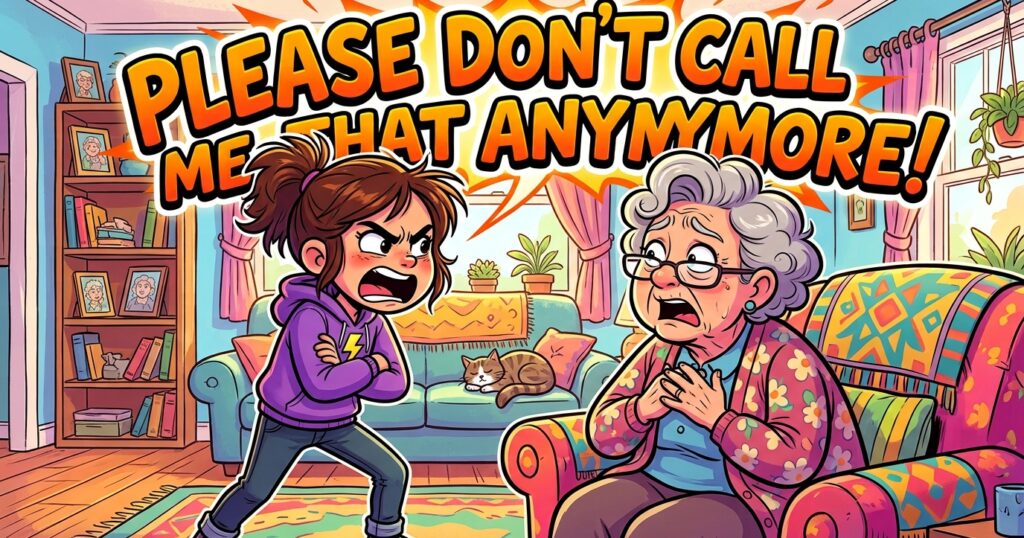
“Grandma… please don’t call me Bunny anymore.”
Your heart sinks.
“Oh,” you say. “But I’ve called you that since you were tiny.”
“I know,” he replies. “I just don’t like it anymore.”
You feel surprisingly hurt. That nickname carries years of love for you.
There is something unexpectedly emotional about a grandchild outgrowing a nickname.
To everyone else, it may seem like a tiny request.
But to a grandmother, that one little word can hold an entire childhood.
You may remember the first time you said it. You may remember tiny hands reaching for yours, sleepy cuddles on the sofa, scraped knees, bedtime stories, birthday cakes, and years when your grandchild seemed perfectly happy to be your “Bunny,” “Peanut,” “Princess,” “Buddy,” or whatever special name belonged only to the two of you.
So when a growing grandchild says, “Please don’t call me that anymore,” it can feel as though something precious is being taken away.
But very often, something else is actually happening.
Your grandchild is growing into himself.
And how you respond can show him whether growing up is safe within your relationship.
Let’s look at each response.
Option A: “You’ll always be my Bunny.”
This response comes from affection.
Grandma isn’t trying to embarrass him. She may even believe she is reassuring him that her love will never change.
And of course, the love behind the nickname may never change.
But the problem is that the grandchild has made a clear request.
When we respond with, “You’ll always be my Bunny,” what he may hear is, “My feelings about this nickname matter more than yours.”
At 13, children are becoming increasingly aware of how they are seen by others. They are experimenting with identity, independence, appearance, friendships, interests, and how they want to present themselves to the world.
What seemed adorable at six can feel painfully childish at thirteen.
Respecting that shift does not erase the younger child he once was.
It simply makes room for the person he is becoming.
Option B: Stop using it around his friends, but keep using it privately.
This may sound like a reasonable compromise.
After all, perhaps the real issue was embarrassment in front of his friends.
And sometimes a grandchild may indeed say, “You can call me that at home, just not at school.”
If he offers that compromise himself, wonderful.
But in this situation, he said something more direct:
“Please don’t call me Bunny anymore.”
That means the respectful response is to take his words seriously rather than quietly negotiating around them.
Even affectionate boundaries are still boundaries.
One of the most meaningful lessons we can give grandchildren is that they are allowed to express reasonable preferences about how they are addressed and treated.
Grandma can teach that lesson simply by listening.
Option C: “Thank you for telling me. I’ll stop.”
This is the strongest response.
It does several important things at once.
First, it acknowledges his feelings without making him responsible for Grandma’s disappointment.
“I didn’t realize it bothered you.”
That tells him his feelings matter.
Second, it appreciates his honesty.
“Thank you for telling me.”
That is powerful.
Teenagers do not always find it easy to tell adults when something bothers them. If they discover that speaking honestly leads to guilt, teasing, or hurt feelings, they may become less likely to speak openly in the future.
But if honesty is met with respect, the relationship becomes safer.
And third, Grandma asks,
“Is there something you’d rather I call you?”
That keeps connection alive.
The old nickname may be disappearing, but closeness does not have to disappear with it.
Perhaps he simply wants his regular name.
Perhaps he has a shorter version he prefers.
Perhaps the two of you will eventually discover a new affectionate name that fits this stage of his life.
Or perhaps no nickname is needed at all.
Love does not depend on one particular word.
Option D: Stop using it, but withdraw a little.
This response is very understandable.
Grandma may genuinely need a little time to adjust.
There is nothing wrong with feeling sad.
Grandparents experience many small goodbyes as grandchildren grow: the last time they ask to be carried, the last bedtime story, the toys that disappear from the living room, the first time they would rather text a friend than sit beside Grandma.
Those moments can tug deeply at the heart.
But if Grandma becomes noticeably distant, the child may misunderstand.
He may think, “I hurt Grandma by telling her what I needed.”
That can make him reluctant to express himself next time.
Grandma can feel her feelings without making her grandchild carry them.
She might privately smile at the memories connected to “Bunny,” perhaps even shed a tear later.
And then she can greet her grandson tomorrow with the same warmth she always has.
Because the relationship is not ending.
It is changing.
And healthy relationships are allowed to change.
The Deeper Lesson
One of the greatest gifts a grandmother can give a growing grandchild is the feeling:
“You are allowed to become someone new with me.”
Children change.
Teenagers change.
Young adults change.
Their clothing changes. Their interests change. Their opinions change. Their boundaries change. Even the way they want to be spoken to may change.
Sometimes grandparents unintentionally cling to earlier versions of their grandchildren because those years were so precious.
But love does not require us to freeze someone in the age when we first adored them.
Real love keeps learning the person standing in front of us today.
You may always remember the little boy who hopped through your kitchen while you called him Bunny.
That memory is yours forever.
But the teenager beside you is asking for something equally precious:
Respect for who he is becoming.
And when Grandma can smile and say,
“Of course. Thank you for telling me,”
she sends a message far more lasting than any nickname:
You can grow, change, and become yourself and you will still be deeply loved here.