Disclaimer: Devoted Grandma is reader-supported. If you purchase anything through my site, I may receive a small commission (at no cost to you). Thank you.
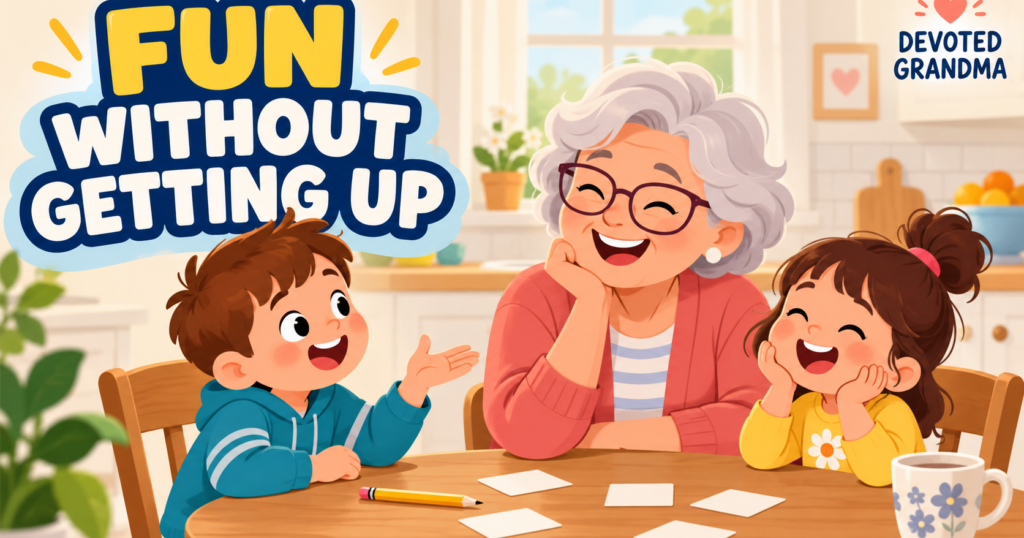
Some of the nicest play happens without clearing the living room, gathering supplies, or asking anyone to get up.
Perhaps everyone is tired after an outing. Maybe you are waiting at a table, sharing a small room, or simply in the mood for something comfortable. Seated play is not a lesser substitute for active fun. It can produce laughter, imagination, good conversation, and the kind of small family jokes that return at later visits.
These nine games require no purchases and no preparation. Most can begin with one sentence. Before choosing, ask, “Would anyone like a quiet game, a silly game, or a thinking game?” A grandchild is always free to say no or suggest something else.
Choose a game that fits this moment
- Only five minutes: Try One-Word Story, What Changed?, or Three Clues.
- Quiet energy: Try Memory Chain, Secret Category, or Fortunately, Unfortunately.
- Silly energy: Try Wrong Answers Only, Sound Detective, or One-Word Story.
- No table space: Choose any verbal game except What Changed?
- Some table space: What Changed? works with a few objects already nearby.
- Not much talking: Try What Changed?, Sound Detective, or the gesture versions suggested below.
- One grandchild: Every game works with two people.
- Several grandkids: Take turns in a circle, with permission to pass.
If two grandkids keep reaching for Grandma’s attention at once, this simple fair-turn plan can help everyone know when their turn is coming.
9 seated games you can start right away
1. Three Clues
First move: Say, “I’m thinking of something in this room. It is smaller than a chair, it has two colors, and we use it often.” Let your grandchild guess, then switch roles.
Adapt it: Give younger children concrete clues about color, shape, or location. Older grandkids can use trickier clues about a person, place, movie, animal, or shared memory. For less talking, write or point to three clues. With a group, everyone gets one guess before another clue is offered. Stop gracefully after each person has chosen an answer, or say, “One last mystery.”
2. Fortunately, Unfortunately
First move: Begin, “Fortunately, we found a boat.” The next person adds, “Unfortunately, it had a hole.” Keep alternating good and troublesome turns.
Adapt it: Younger children may need a familiar setting, such as a zoo or birthday party. Older grandkids can make the plot more surprising. For a low-talking version, each person may add only three words. With two people, alternate lines. In a group, move around the table and allow anyone to pass. End when the characters arrive home, solve the problem, or when someone supplies a cheerful final line.
3. What Changed?
First move: Place three nearby objects on the table and say, “Take a good look, then close your eyes while I change one thing.” Move, remove, or turn one object.
Adapt it: Use two obvious objects for younger children and five subtle changes for older ones. This is naturally a low-talking game because pointing can replace guessing aloud. One-on-one players take turns making the change. In a group, one person changes the display while everyone else looks away. Finish after every willing player has created one change.
4. One-Word Story
First move: Say, “Once,” and invite the next person to add exactly one word. Continue until a very unusual sentence becomes a story.
Adapt it: Younger children can contribute one word or one short phrase. Older grandkids may enjoy choosing a genre, such as mystery or space adventure. For less talking, use gestures for simple action words. With two people, go back and forth. With a group, move in order and let anyone say “pass.” Stop at the end of a sentence, or announce that the next round must bring the characters safely home.
5. Wrong Answers Only
First move: Ask, “What is a spoon used for?” The rule is that every answer must be cheerfully incorrect, such as, “Teaching ants to row.”
Adapt it: Give younger children familiar objects. Ask older grandkids stranger questions, such as why socks disappear. For a quieter version, point to an object and let the other player mime its wrong use. One-on-one players can trade questions. In a group, everyone answers the same question once. End after three questions, or while the answers are still making everyone smile.
Silliness should feel shared, not aimed at one child. If teasing starts to sting, this guide to what to do when a family joke hurts offers a gentle way to repair the moment.
6. Memory Chain
First move: Say, “I packed a picnic and brought an apple.” The next person repeats the sentence and adds one item.
Adapt it: Let younger children use gestures or receive a helpful clue. Older grandkids can choose a theme, such as items for a moon trip. For low talking, point to imaginary items while naming only the new one. With two people, build one shared list. In a group, do not eliminate anyone for forgetting. Simply supply the missing item together. Stop when the list reaches ten, or when remembering it stops being fun.
7. Secret Category
First move: Think of a simple category and say, “A robin belongs in my secret group. A chair does not. What about a blue jay?”
Adapt it: Use clear categories such as animals or round things for younger children. Older grandkids may enjoy hidden rules, such as words with double letters. For less talking, let players point to nearby objects and receive a nod or head shake. With two people, guess together. In a group, take one suggestion from each person before revealing the rule. End after the category is discovered or after three generous hints.
8. Sound Detective
First move: Say, “Close your eyes and listen. Name one sound you can hear.” It might be a clock, traffic, a refrigerator, or a bird.
Adapt it: Younger children can imitate each sound. Older grandkids can rank sounds from nearest to farthest or invent a story that includes them. This game already needs little talking, and pointing toward a sound is enough. With two people, compare what each person noticed. In a group, listen silently for twenty seconds, then share one at a time. Stop after five sounds or when the room becomes too quiet to offer anything new.
9. The Question Behind the Answer
First move: Give an answer first, such as, “A purple umbrella.” Everyone invents a question that could have produced it: “What did the queen carry to the picnic?”
Adapt it: Give younger children easy answers, such as “three cookies.” Older grandkids can make questions funny, mysterious, or surprisingly sensible. For a low-talking version, offer two possible questions and let the child point to a favorite. With two people, take turns supplying answers. In a group, everyone invents a question for the same answer. End after each person has supplied one answer, then choose a favorite question together without turning it into a serious contest.
Make stopping part of the fun
A good game does not need to fill the entire visit. It may last three minutes, end in the middle, or lead naturally into a snack or conversation.
Watch for shorter answers, wandering attention, or a child beginning another activity. You can say, “That was fun. Shall we do one more round or be finished?” Accept either answer warmly.
When grandkids know they can decline, pass, change the rules, or stop, an invitation to play feels lighter. Pick one game that fits the moment, make the first move, and leave room for them to make it their own.